
Garden Path Sentence
Some recent experiences while reading Proust, and their descriptions


I recently finished Swann’s Way, the first of Marcel Proust’s seven-volume magnum opus, In Search of Lost Time. A fictionalized, composite account of Proust’s circle circa fin de siecle France, A la recherche de temps perdu is also the world’s longest novel, according to Guinness. Multiple main characters are observed across the Belle Epoque, in and among one another’s company, falling in and out of love and afflicted with the petty concerns and jealousies endemic to interpersonal relationships, all told from the divided perspective—young and old—of Proust’s fictional foil, M.—Marcel. Having recently recognized in my own writing a tendency to wordiness in service of fine, near-inconsequential detail, I thought I’d try an author famous for writing about his own past in a similar way. Despite not knowing much about the famously-hard-to-summarize plot going in, I knew I’d at least get to witness the famous madeleine scene firsthand.
…a new book not as a thing having many counterparts, but as a unique person, having no reason for existing but in itself…
—Marcel Proust, Swann’s Way, trans. Lydia Davis
Swann’s Way is further subdivided into four parts, the first of which has middle-aged Marcel unable to sleep, thinking back to his time in Combray, the town in which he spent several summers as a young boy. He reflects on his early attachment to his mother and the strategies he employed to steal her away from the company downstairs—one of whom is M. Swann—one night so she could tuck him in. Toward the end of section one, the voice starts waxing philosophical about the inability to voluntarily retrieve forgotten memories.
Dead forever? Possibly … It is a waste of effort for us to try to summon it, all the exertions of our intelligence are useless. The past is hidden outside the realm of our intelligence and beyond its reach, in some material object (in the sensation that this material object would give us) which we do not suspect.
My wife and I were sitting at a busy restaurant in Portland in May. We’d ordered and were chatting, about anything and nothing. The dark chartreuse of my drink matched exactly her pen. I liked the jacket on the man to her right. One of the young men to my right is a middle school teacher; I can see it. I opened Swann’s Way and continued to read. Shortly thereafter something in the text telegraphed to me I might be coming upon the aforementioned scene. Up until then, I was mostly engaged, though deep down still wondering where it all was going. Like the clicks of a geiger counter that turn to one long buzz in the proximity of something important, I felt my focus increase. The ambient noise died down and the other diners reverted back to pre-speculation specters. I sit up in my chair and the hair stands up on my arms as the narrator, released however temporarily from his reverie, briefly alludes to an animistic Celtic belief in which departed souls inhere into random objects which then await for their survivors to happen upon them. He then alights on a specific day in winter when, against his first impulse to refuse a cup of tea proffered by his mother, decides instead to take it, along with an unassuming, familiar cookie, which was, he writes, “molded in the groove of a scallop shell.” The tense subtly switches to present. It’s here. Upon tasting a few crumbs in a spoonful of tea, he remembers, very poignantly and with great detail, another time in childhood during which he shared cookies and tea in the company of his aunt. I close the book. The restaurant floods back in. My breakfast would arrive soon, but all I wanted, like a bit of madeleine in some lime-blossom tea, was to soak in that moment. One of the most famous scenes in all of literature. We finished, paid, left the restaurant. On our way back to the truck, we spied a French bakery. I ducked in and asked if they had any madeleines. Alas.
Marcel’s epiphany—that everything heretofore experienced is immanent—was successive, gentle. After the “delicious pleasure,” he tries several more times—bite, sip, bite sip—to bring back that first feeling, without success.
I put down the cup and turn to my mind. It is up to my mind to find the truth. But how? Such grave uncertainty, whenever the mind feels overtaken by itself; when it, the seeker, is also the obscure country where it must seek and where all its baggage will be nothing to it. Seek? Not only that: create.
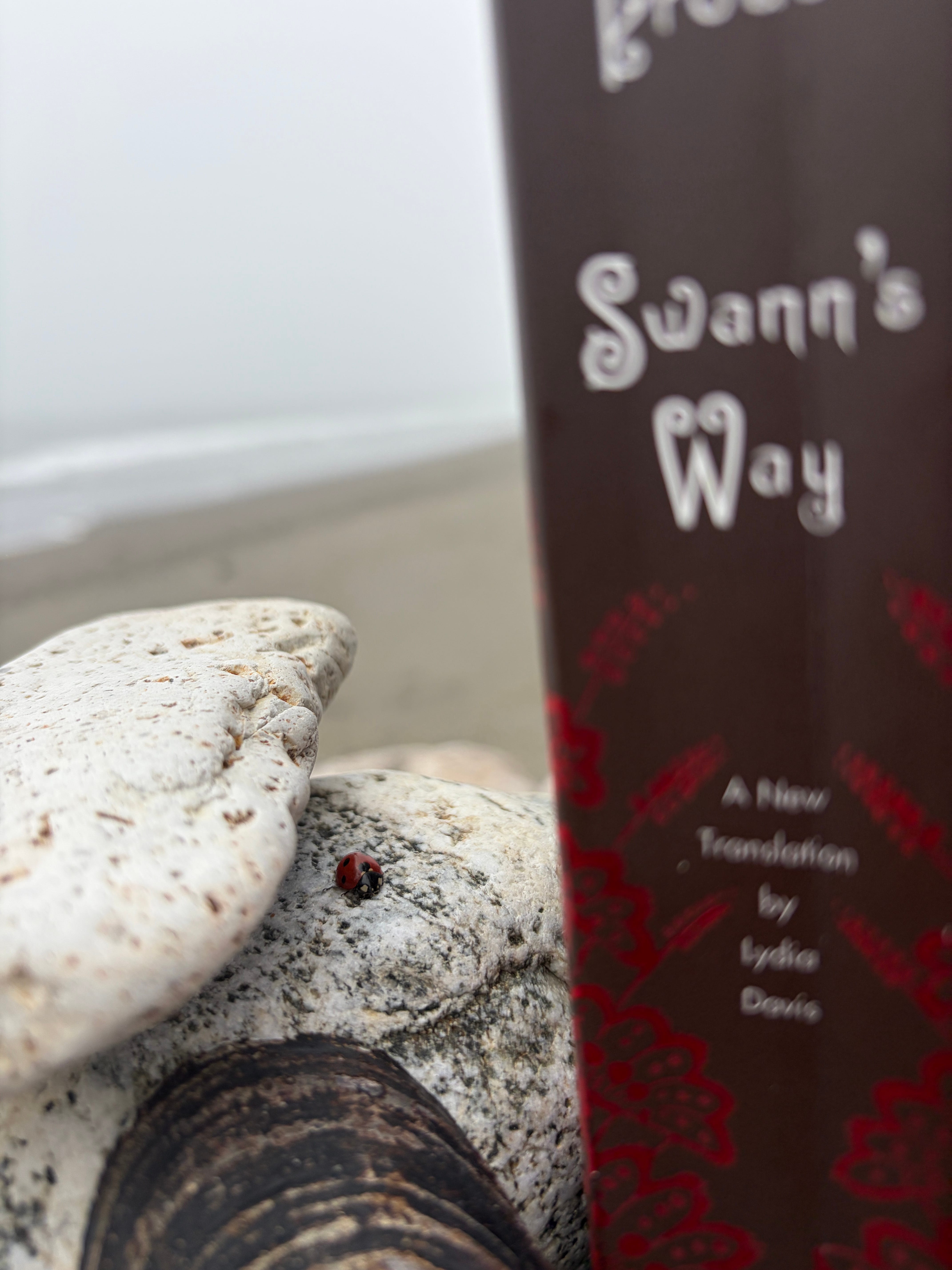
The narrator is newly aware that it is going to take effort to excavate and represent what his mind is now indiscriminately reminding him of. These erstwhile, yet now revivified sensations, about the rest of the town and life outside his childhood bedtime setting, the surrounding gardens, streets, and fields, comprise the book’s second section. Over the years, I’ve come to view my mind as notoriously fickle and incorrect. What’s important filters down and stays, but with the human tendency to passively confabulate, approximate and forge, my revery is skewed and biased. That which actually happened gets mingled with interpositions, interpolations, and even others’ interpretations, and insofar as I am able to reconstruct it in any detail, there’s likely more wrong with it than right. And it goes without saying that explaining, writing, or otherwise depicting the past through some medium concretizes but one angle and only one moment. There’s something about Proust’s recollections, however, that sidestep these objections. When I was in the middle of his stream of consciousness, nothing I could point to felt forced or fake—and nothing less than artful in the service of the larger story. There’s truly nothing like it. He then goes on to describe a second epiphany, one that would in turn inspire him to become a writer. Both epiphanies—a highly tuned sensitivity to sense-memory, as well as a drive to write—go hand in hand. And it goes further. The mentation, this network of psychological movements, moments and associations inspired an infirm, introverted individual, Proust, to produce the longest novel in history. If one were to take a minute slowly taking in each of one’s five senses—to say nothing of the sixth, let alone memory—one could spend an entire afternoon narrativizing. But to what end? So fine-grained is Marcel’s description of, and Proust’s depiction of, Illiers, the little community in the north of France on which Combray is based, that Illiers permanently changed their name to Illiers-Combray in honor of the centenary of Proust’s birth.
While I’m hesitant to call what Marcel experienced with the madeleine an epiphany, his call to writing was nothing but. It’s somewhat the reverse for me. Writing, in other words, came gradually over time. It was just journaling, a little poetry. The journaling then hit a higher degree of obsessiveness when an admonition on the part of my father encouraged me to write by way of self-therapy. A few years later, when I broke out of my non-audience genre of journaling and felt the call to go beyond and write online, it was a concession. When, in my mid-twenties, I felt I had a lot to say to the world—all I’d found in the wake of the life-changes I’d gone through up until that point—I didn’t feel comfortable enough in front of a camera to monologue. But in writing this piece, wondering where it all was going, I remembered that I’d experienced a true point-in-time epiphany myself many years ago that would change my perception of, not the past or memory in general, but the world of dreams. I’ve never done anything other than journal about it, but it was no less sensational, no less foundational to who I would become in the years that followed.
I don’t know exactly what year it happened, but I believe it was during my mid-teens. Enough time had elapsed and life transpired to make me forget all about it. I was sitting in the passenger seat one day, my dad driving. He pulled up to an intersection, across from which stood an inconspicuous, preppy-professional clothing store. And it’s not all that busy a street, so it’s likely he stopped, turned, drove on in as much time as it took you to read to from the beginning of the paragraph, here. But in that brief moment beholding M. Kaufmann’s boutique, a dream I’d had nearly a decade prior, when we were living in a small suburb of Los Angeles, was unseated from the void. I’d forgotten that I’d forgotten it and I believe to this day that I would never have had any recourse nor reason to recall it, so removed was I from that chapter of my childhood. It follows.
I am in a large forest clearing. Dappled sunlight on the lawn. Dark, but not ominous, woods surround the scene, in the middle of which sits a large, stately house. Just enough time to apprehend it before I find myself in its basement, dry, cool, unlit. At one end of the long, concrete-floored room stand three pillars, each of which feature an inbuilt aquarium at eye level, lit from within. Aquatic light plays on the walls. I am then back outside, above ground as smoke from the burning room below rises through grass. Burn victims rushed on stretchers into waiting ambulances.
The recollection was quiet but intense, and gone as soon as it had come, leaving in its wake a profound sense of mystery. I couldn’t have told you where the original oneiric imagery had come from, and I don’t know what it was about 625 East Main that would play the madeleine to my mind. Aside from the massive redwood to one side, there was nothing about it, not the bland white siding, nor its wares, to endear it to me. I’d been in Oregon for several years, but didn’t recall seeing it before then. And the boutique would eventually close—an aquarium store would open in its place; it’s now a gym. The tree, felled. The dream, however, became a source of strength, in all of its odd imagery and potential symbolism, for the years that would follow. The forerunner for a series of other dreams that anchored my emotional state in the wake of my parents’ divorce.
After relating his years in Combray, M. proceeds to go back even further, reconstructing the story of M. Swann’s and Odette’s doomed first relationship. He introduces the supporting cast and their “little clan.” Recognizing much of my former self in many of the callow, ill-advised thoughts and behaviors in which Swann engages, I can only say here how grateful I am for my wife. The following refers to Swann, but could just as easily be me, still:
It appeared that he dared not have an opinion and was at his ease only when he could with meticulous accuracy offer some precise piece of information. But if that was the case, he did not realize that to postulate that the accuracy of these details was important was to profess an opinion.
Proust’s style at once infusing, validating, and also offsetting my own, I’m relieved to leave off, at least for the summer, reading the rest of Lost Time—without feeling the need to lucubrate exactly like him. Each one of his overlong sentences undulates with grace and fluidity, managing at once to convey depth, variety, the off beam metaphor or simile or two, and, more often than not, at least one truly profound kernel, made all the more poignant precisely because of its abundant context. This is Proust. And despite the length of those moments, those sentences (the longest upwards of 600 words), the novel flows. The fore, for me, however, from this foray, is both a newfound resolve to continue including seemingly throwaway details, as well as a fresh appreciation for the extended simile and metaphor. The former strengthens my resolve while the latter drips in a little oil to any grinding gears. I can do without the catty sniping and oath avowal on the part of the bourgeoisie to refuse the company of anyone unlucky enough to be born a boor. Throughout the novel, the atmosphere in which I’ve lived and grown and the proxemics in which my psychological phenotype has taken shape, so to speak, stood out in sharp relief to Madame Verdurin’s stilted salon in which she holds forth and holds court. I do confess that I do see it—a sense of elitism and entitlement where I’ve grown up; tell me, where in the world or in human history is it not? Only God knows. But I’ve spent much of my adult life alone, looking in, supremely grateful to not have, shall we say, the wrong kind of crowd with which to hang. I have been a part of three circles from which I’ve been extricated. Perhaps they were the three pillars in my dream?
When one comes in and around others whom they are blessed to know, the wonders that can be mined, as it were, of beauty, symmetry, compassion and pleasant surprise, far outweigh the torments to which Proust subjects his poor characters. Swann inveighs against Odette and the shallowness that, in his opinion, she mistakes for profundity:
“You’re … a fish without memory or reflection which, as long as it lives in its aquarium, continuing to mistake the glass for water, will bump up against it a hundred times a day.”
Without memory or reflection, what do we have to go on?