
Anon Believer

Christopher Nolan’s recently released adaptation of Homer’s Odyssey got me thinking about my quondam time in the classics. I saw it with my wife last week and enjoyed it very much. Spare Mediterranean vistas; the lonely feeling of a hundred million global population beyond the horizon. The Trojan horse was beautiful—I’d love to have been able to see the prop up close outside that theater in LA. The way it stood up in the surf had to have been an academic detail discerned, discovered by Nolan, buried deep in some monograph on the Iliupersis. Wait. I had to correct myself. This is fiction, mostly. The horror of the sirens. Polyphemus’ appetite. A father and his adult son sat to my right. Halfway through, I heard a gentle snoring and figured the dad had nodded off. On the way home, however, Shawnah corrected me. It was the son that fell asleep. She heard Dad gently chiding him awake when the credits started rolling.
“Tell me about a complicated man.”
—The Odyssey, Book 1 (trans. Emily Wilson)
My father unenrolled me from Wilson elementary about a quarter of the way through sixth grade. I’d been there midway through third, a hard year. Fourth and fifth were kinder. I attained to some semblance of tween-hood during the latter, having been able to slough off some naive personality traits that made me a target for bullies. It was 1995. The Nintendo 64 would release the following year and in two years I would get my first real job delivering newspapers. It was halfway through the most formative period of my adolescence, and halfway through the most fecund, in my opinion, decade of the 20th century—but that’s a story for another time. It was the day I’d intended to ask out a girl I’d seen the morning my dad and I made our way across the street to enroll me back in 1992. Three years of ever steadily declining academic performance, all the while trying to grasp whatever this new normal was. I remember the pearlescent plastic buttons on the Oxford shirt I’d angled for at Wal-Mart over the weekend following my final Friday in public school. I wanted to wear something nice. I caught sight of her again a few years later in the sports page. She was on the running team. A freshman, maybe. Same grade as me.
It was the year Medford began restructuring its junior highs into middle schools. Sixth was seceding, so to speak, from upper elementary and Wilson was piloting a departmentalized bell-schedule-type setup in lieu of the self-contained elementary model I’d always known. My homeroom teacher, Mrs. Vines, was cool throughout, but my dad was frustrated. I wasn’t doing well in this unusual new situation and he became offended when another teacher—longsuffering and beleaguered for sure—hung up on him while he was castigating her. In a fit of pique he averred to my mom and me that he could do better. Though what stood out in starkest relief from the shift I’d undergone was nothing so much as this sense of the end of an age. My education was over. This void opened up where once a future had been, however subconscious and taken for granted. I knew I’d never receive the knowledge I needed and, if ever I did find myself, it would be without the connections afforded by the system. I would therefore fail to matriculate into adulthood. My harried mom, a full-time nurse, was frantic, coming home one day, trying to get me to read up on the Civil War. One of the last pieces of information I’d apprehended in class was this word, “Appomattox.” Hard-pressed to explain its significance under interrogation, I also mispronounced it and then callowly insisted that it was how the teacher had said it. Either way, that detail set off my dad, himself a Virginia native. I very quickly absorbed all these energies which in turn gave rise in me to a serious complex of ignorance, shame, and further posturing. I ran into a classmate, James, one afternoon. It had been a few months. I’d known him since third grade, but pretended I didn’t.
O would to God the day
That first gave light to me had been a whirlwind
And borne me to some desert hill, or hid me in the rage
Of earth’s farthest seas, rather than…
—Homer, The Iliad, Book III (trans. George Chapman)
My education didn’t end. It just didn’t look like it was directed anywhere. It was the age of the nascent Web and Dad got me a desktop PC with some accompanying software. I was online in short order. It hadn’t dawned on me yet that much of what was knowable—whatever it was that I didn’t memorize or learn or get exposed to yet—was accessible to me now. But I didn’t exactly take to learning all I could about all I could just because I was now traveling the information superhighway.
“There’s wholesale acceptance about when the modern version of the internet began-it emerged during the 1990s.” —Chuck Klosterman, The Nineties
Five years went by. Barnes and Noble opened up across town, with its attendant Starbucks and promise of a “piazza where people could mingle and mix,” to quote Joe Fox from You’ve Got Mail. My first-ever tall hot chocolate, with its shock of cold whipped cream, forever after altered my brain chemistry, I think. I was standing in History looking over at the columns of the porch in the children’s section when I sipped. I’ve dreamt about the exact place more than once. The bookstore was an oasis of culture in an otherwise dreary, boring, mostly lower-middle class region of a state famous, or at least notorious, for a great number of things (only double-sided flag, for one), none of which seemed in any way to affect or at least influence the atmosphere. It provided for me a repository of information and knowledge. Curated, organized, easily accessible, to say nothing of the confident, kind booksellers, many of whom we already knew.
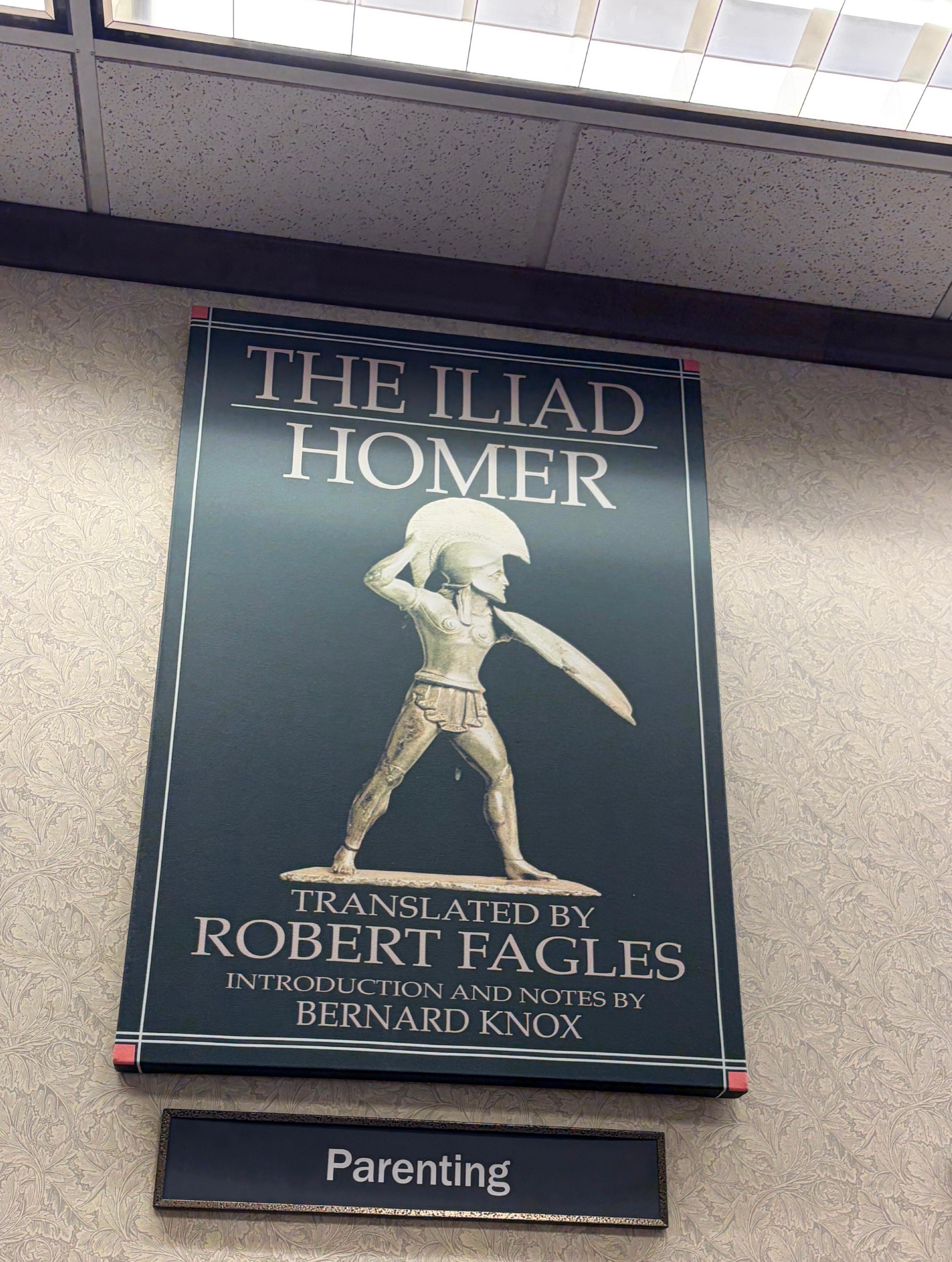
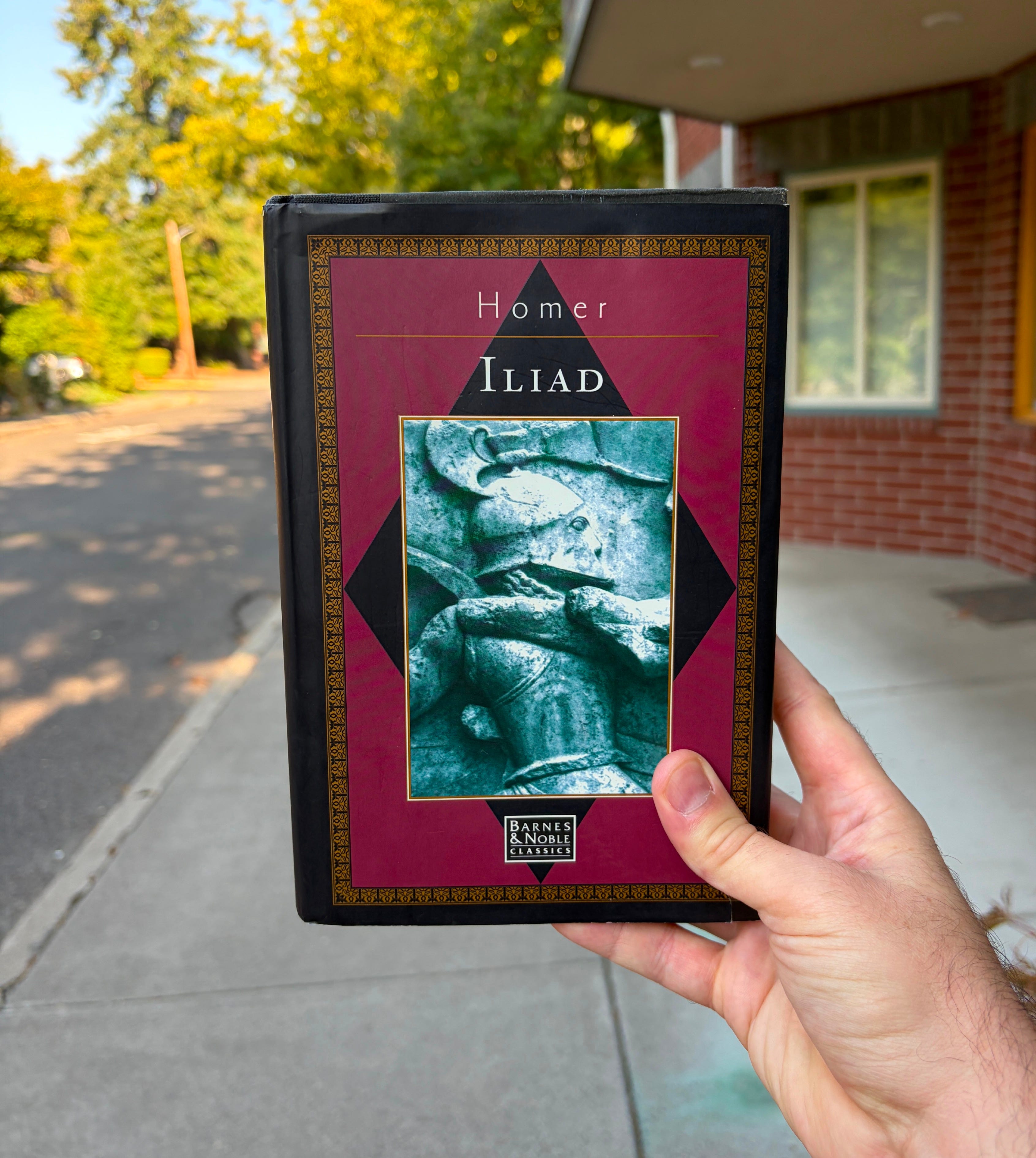
Maybe it was a first feeble attempt at solving this crisis of ignorance. Maybe it was a fellow customer who informed me that it’s what a student my age—a sophomore at this point —would be reading were they in school. Either way, it was no doubt mostly owing to the prominent image of an older edition on the upper wall of the store that I’d become aware of Homer’s Iliad and so figured I’d start there. What tipped me over, however, into serious interest was this concept of other gods. Dad talked about God all the time at home and despite our occasional study of the Books of Moses and my passing understanding of the idea of ancient idol worship, the notion of a pantheon had very simply not come up. To have other deities vying for one’s attention felt to me, not scandalous, necessarily, nor, really, sacrilegious. More like a piece of a puzzle I didn’t know I was missing. So I tried Iliad—a prose translation—and got through, barely. I didn’t comprehend or, really, remember much of what I’d read. The scenes of violence, of spear points entering and exiting. The very specific, magically-realistic detail of Achilles riding around Troy with Hector’s supernaturally undefiled corpse tied to his chariot. The Trojan plain. Apollo. These few things did I retain to the neglect of most else. Nonetheless, I proudly owned the fact I’d polished off a classic, unable to explain in any detail the overarching themes or, really, the plot. It was about a war. This was back during the age of Cliff’s notes and had I had one, I would have fared far better. I remember very clearly the stuffed rack of black-and-yellow striped study guides further down the wall.
“When you read a book as a child, it becomes a part of your identity in a way that no other reading in your whole life does.” —Kathleen Kelly, You’ve Got Mail
By now nearing 16. Can’t say it became a part of my identity, but I knew enough that I needed to seek out Odyssey and keep expanding. Maybe it was guilt, perhaps disappointment in the fact that I wasn’t able to talk intelligently about it. Ever since moving to Oregon, something inside had gone quiet. Not scheming, exactly, but perspicuous, shrewd. I never informed either parent about what made third grade so hard, nor did I feel I could confide in them about my social struggles or my deep yearnings. My dad had done his darnedest to instruct me starting out, but the fervor quickly died. He started with the aforementioned software and then signed me up for a brief stint in a mail-order videocassette homeschooling program. The penultimate effort before letting it go was assigning a panoply of educational websites, but alas. It was a dark age. My own personal information age had yet to begin. The final step in this experiment in unschooling was getting me a part-time job at the bookstore. I would hire on when I was 16.
In between finishing Iliad and obtaining a copy of Odyssey I happened upon a book in the bargain section that purported to tell the story of what took place post Hector’s funeral and prior to Odysseus’ journey home. I assumed it was exactly what the subtitle said: “What Homer didn’t tell.” I’d known enough by then to be intrigued, but was still ignorant of Virgil and the Epic Cycle. The War at Troy, by Quintus of Smyrna, presented to me as yet another text in the ever-expanding-yet-somehow-cohesive Greek mythos. I couldn’t have known that it was essentially 1,600-year old Homeric fan-fiction. But also none of this mattered: I knew what must be done. The same impelling toward Iliad and Odyssey now applied to Quintus. I couldn’t move forward until I made it my own.
One morning thereafter, back asleep after having finished my route, I dreamed God was standing by my bed. He was clad in a cloak the color of the void. Despite this, I knew who it was. He asked me when I got up to read my Bible, “then,” he said, “read The War at Troy.” It was quiet, clear, simple. I awoke. And while I don’t remember what I did end up doing, it was something other than what was asked.
I suppose I’d have a conception of [God] right? I capitalize the initial letter to indicate a proper noun, a name or title of address. It feels weird to type or write the word in all lowercase without using a determiner. “An” is incorrect and “a,” as in “the single deity in my pantheistic society to which I’m devoted” also doesn’t work. I can’t believe that anything presenting as part of a pantheon would be on the same order as the—and I hope you’ll forgive the apophasis, or affirmation by a negative—individual to whom I am referring. I’m not a henotheist. The definite article, while the more apt, doesn’t carry the same connotation as the oneiric recognition I felt. Without a majuscule ‘g’ it’s almost a contradiction in terms. And forgive me if I’ve come across here as pedantic. It was a being, a figure. I know that, dark and inscrutable though it was, it wasn’t merely some introjection-projection of my father’s influence. At the very least it was “God” to me in the same way you might exclaim, “Oh my God!” Before then I’d never consciously met him, but soon as I awoke, I knew. It’s the only encounter like this I’ve ever had. I’ve never brooked the possibility or belief that it was maybe an alien or an angel, and that it asked me to read my Bible first signaled to me it wasn’t Zeus. I suppose I could use a gender-neutral pronoun.
Every so often the store would receive these multi-carton shipments, “waves”—the most random, wide-reaching, varied titles—and one of the most unique aspects of my early time as a bookseller. Books large, small, old, new, from all over the country. I once bought a couple of really nice leather-bound journals for next to nothing. One box had a single volume of Goblet of Fire in braille, this thick, pure white, floppy tome. One day I found a copy of the Durants’ massive volume on Ancient Greece. Mrs. Vines happened by one afternoon while I was reading it on a break outside Starbucks. She pinched a hundred unread pages and told me that “in college, this is what you’ll have to get through each night.” She wasn’t wrong. Many years later, when I was back in school I reread portions of both Odyssey and Iliad and fell especially in love, almost guiltily, with Gilgamesh. A decade of bookselling would pass by the time I felt compelled to reify some semblance of cohesive, and by now compulsory, education on my own, long before I knew what I would want to go back to school for. When finally, and with a little more wisdom and experience, I decided to open Pandora’s Box, cracking the starry firmament of literature, I was overwhelmed. Ten years of civil war, followed by a monster-fraught voyage back to myself, I could only take in one tome at a time while the rest of the world around me crumbled and washed away. And yet I still hadn’t read The War at Troy. This vast bubble of ignorance would slowly deflate, but alongside it was this gnawing regret that I could have started a long time ago and be that much further along. I finished Quintus and followed up with The Odyssey. I then happened upon the Larsens’ Campbell biography, which in turn led me to the The Hero With a Thousand Faces. The rest is history.
The Roman statesman Cicero once claimed, wrote Pliny the Elder, that the Iliad was once inscribed on a piece of parchment so minuscule that it fit inside a nutshell. And while the modern connotation of extreme summarization comes to us from the Bard, that Homer’s epic is in some small way tied to the concept of condensing vast quantities of information is hilarious to me. Especially considering what all there is worth wrapping our minds around and the comparatively short amount of time we have to do it. I now teach in one of the classrooms I’d have frequented during the years following my unwilling exile. Looking back with what I now know and see of the world, the amount of knowledge I’d have accrued between sixth grade and high school is negligible, likely measured in megabytes—in a nutshell.
“For many readers, Homer’s gods are among his most successful creations, and they are surely the finest gods for literary purposes that man has ever invented.” —Frederick Combellack, The War at Troy
Toward the end of Odyssey’s third act, Athena—who only ever shows herself to Odysseus—disappears. She’s there. And then she’s gone. But before she goes, the viewer sees in her the same face a young priestess, one of the victims from the Trojan incursion. Is Nolan implying the age of gods is over? That they’ve never been? That’s what I got, though I may be reading too much into it. Penelope and Odysseus then sail into the sunset, during which time he tells her that, “this age of bronze is at an end.” A line that has since suffered a number of snarky asides online. Insofar as one man is able with any accuracy to call such a large shot, I feel that the age of information—at least this age of information-as-knowledge in which we’ve waded around and become inundated with for the past three decades—is about up. What began when I was forcibly exiled from compulsory education as the dawn of a new age of connectivity, and that morphed into one of abundant knowledge, has become something that only God knows. Don’t get me wrong, we are still as immured in the information age as defined however abstrusely by Claude Shannon’s 1948 master’s thesis, and will be for some time. But the signal to noise ratio right now is incredibly sparse, in my opinion. So what age is it? I’ve heard “the Plastic Age,” and more than once has “the age of AI” been tossed around. The author Daniel Pink coined “the Creative Age” in his book A Whole New Mind, which I like, and James Bridle’s New Dark Age is essential reading. I think it will be for some time.
“I offered her some of the pistachios I’d brought with me, a present from my uncle. They are a specialty of Iran that is often given when someone is going abroad. We consider our pistachios to be the world’s best…” —Marjane Satrapi, Persepolis
As a freshman, the artist and author Marjane Satrapi—born and raised in Iran—was sent to Austria to finish high school. Her comic Perspolis tells the story of her time growing into young womanhood under an oppressive regime, all the while struggling to reconcile her individuality, talents and aspirations, faith, culture, and family expectations. Hilarious and poignant, what struck me most was her experience in Vienna. Homelessness, serious illness, poverty, rejection, loneliness, acute stress and worse—in short, everything I was afraid was inevitable when I was taken out of school—does she encounter and surmount. The night before her final, God appears to her in a dream and tells her exactly what she’ll be writing on in her baccalaureate. She ends up getting the highest score in the school.
There is someone out there who wants us to succeed.